Pain management in ayurveda is often summed up as treating pain "at the root". It is an appealing phrase and a partly fair one, but it can hide the practical questions people actually have. What happens in a session? Which kind of pain does it suit? Is there evidence behind it? And when is it the wrong place to start? This guide answers those plainly, for anyone living with long-standing back, neck, knee, shoulder or joint pain who wants to know what they would be signing up for before they book.
Pain Is Not One Thing
Pain, as the International Association for the Study of Pain defines it, is both a sensory and an emotional experience, tied to real or possible tissue damage. That definition explains why two people with the same scan can feel very different amounts of pain, and why mood, sleep and stress change how bad it feels.
Pain that lasts longer than about three months is generally treated as chronic, and by that point the original injury may have healed while the pain carries on. It also comes in different kinds. Muscle and joint pain tends to be dull, achy and worse with certain movements. Nerve pain is more often burning, shooting or tingling. Many people have a mix.
This matters because a treatment that suits a strained muscle may be the wrong one for an irritated nerve. Any serious approach to pain, including pain management in ayurveda, starts by working out which kind it is dealing with.
How Ayurveda Looks at Pain
In Ayurveda, pain is described by terms such as Shoola and Vedana. Vedana is a wider word than "pain": in classical usage it also covers sensation and perception in general. That is a clue to how the system thinks. Pain is treated as one signal among several, to be read alongside sleep, digestion, energy, mood and daily habits.
Most pain of the stiff, aching, shifting or cold-sensitive kind is attributed mainly to Vata, the principle associated with movement and the nervous system. Burning, hot and inflamed pain is linked to Pitta, and heavy, dull, swollen pain to Kapha. Many chronic conditions involve more than one of these at once.
Reading the type of pain
Classical texts describe pain in rich, specific terms: pricking, splitting, piercing, binding, pain that appears on bending or stretching a joint. Practitioners use the quality of the pain, what triggers it, when it is worse and what eases it as clues to what is going on. It is a traditional lens, comparable in spirit to the way a modern clinician uses the history of the pain to separate muscle problems from nerve problems.
Treating the cause, not just the signal
A review of pain in classical Ayurvedic literature, published in the Journal of Ayurveda and Integrative Medicine, argues that Ayurvedic management changes with the cause and stage of a condition rather than simply interrupting pain signals. That is a fair description of the intent. It is also worth remembering what such a review is: an analysis of texts and concepts, not a clinical trial, so it explains the logic of the approach without proving how well it works.
In day-to-day practice, "the cause" means things like how you sit and work, an old injury, how you sleep, how you handle stress and how your digestion is behaving. That is why pain management in ayurveda looks at those habits along with the painful area.
The Therapies Behind Pain Management in Ayurveda
The table lists the therapies that come up most often. A physician chooses and combines them according to your assessment, and most people receive only a few of them.
| Therapy | What it involves | Where it is typically used |
|---|---|---|
| Abhyanga | Warm medicated oil massage | General muscle tension, stiffness, recovery |
| Swedana (including Pinda Sweda and Patra Pinda Sweda) | Herbal steam or warm herbal poultices | Stiff joints, muscle spasm, back and neck pain |
| Local basti (such as Kati, Greeva or Janu basti) | Warm medicated oil held over the lower back, neck or knee in a ring of dough | Persistent localised spine and joint pain |
| Lepa | A herbal paste applied to the area and left to dry | Localised swelling, sprains, inflammation |
| Marma therapy | Gentle pressure on specific points | Tension and pain, traditionally |
| Panchakarma procedures | Structured courses of cleansing and balancing therapies, such as medicated basti | Long-standing, chronic patterns |
| Internal medicines | Herbal formulations, decoctions and oils | Supporting the external therapies over weeks |
Some centres also use procedures such as agnikarma (therapeutic heat) or leech therapy for specific indications. These are not part of everyday programmes and need a physician's judgement.
Oils, heat and manual therapy
Most Ayurvedic pain programmes are built around warm oil. Medicated oils are massaged into the painful area and surrounding muscles, and heat from steam or poultices follows. The reasoning is that warmth and oil help muscles relax and joints move more freely, while the slow, rhythmic nature of the massage settles the nervous system. This is why many people with chronic pain report feeling calmer as well as looser after a session, an effect that fits with what is known about how stress amplifies pain.
At Kayakalpa, the herbal oils (thailams) and decoctions are prepared in-house. The clinic also offers Alignment therapy and chiropractic therapy for people whose pain has a mechanical component.
Panchakarma and local basti
For long-standing conditions, particularly joint and spine problems, a physician may recommend Panchakarma or a course of local basti. These are structured, supervised courses, and they are not for everyone. Age, strength, digestion, other illnesses and the stage of the pain all affect whether they are suitable. The clinic's Panchakarma page describes how the process works.
Medicines, diet and daily routine
Internal medicines are often part of a plan, but they carry the main safety caveat in this field. Some Ayurvedic preparations, especially metal-and-mineral formulations known as rasa shastra, have been found to contain lead, mercury or arsenic. Take oral medicines only from a physician, from a reputable manufacturer, and tell your regular doctor about them.
Diet and routine are the quieter part of the programme. For Vata-type pain, Ayurveda advises warm, freshly cooked food, regular meal times and a steady sleep schedule. This is traditional advice rather than proven treatment, but it is low-risk, and consistent sleep is something that does help with pain generally.
Conditions People Most Often Bring to an Ayurvedic Pain Clinic
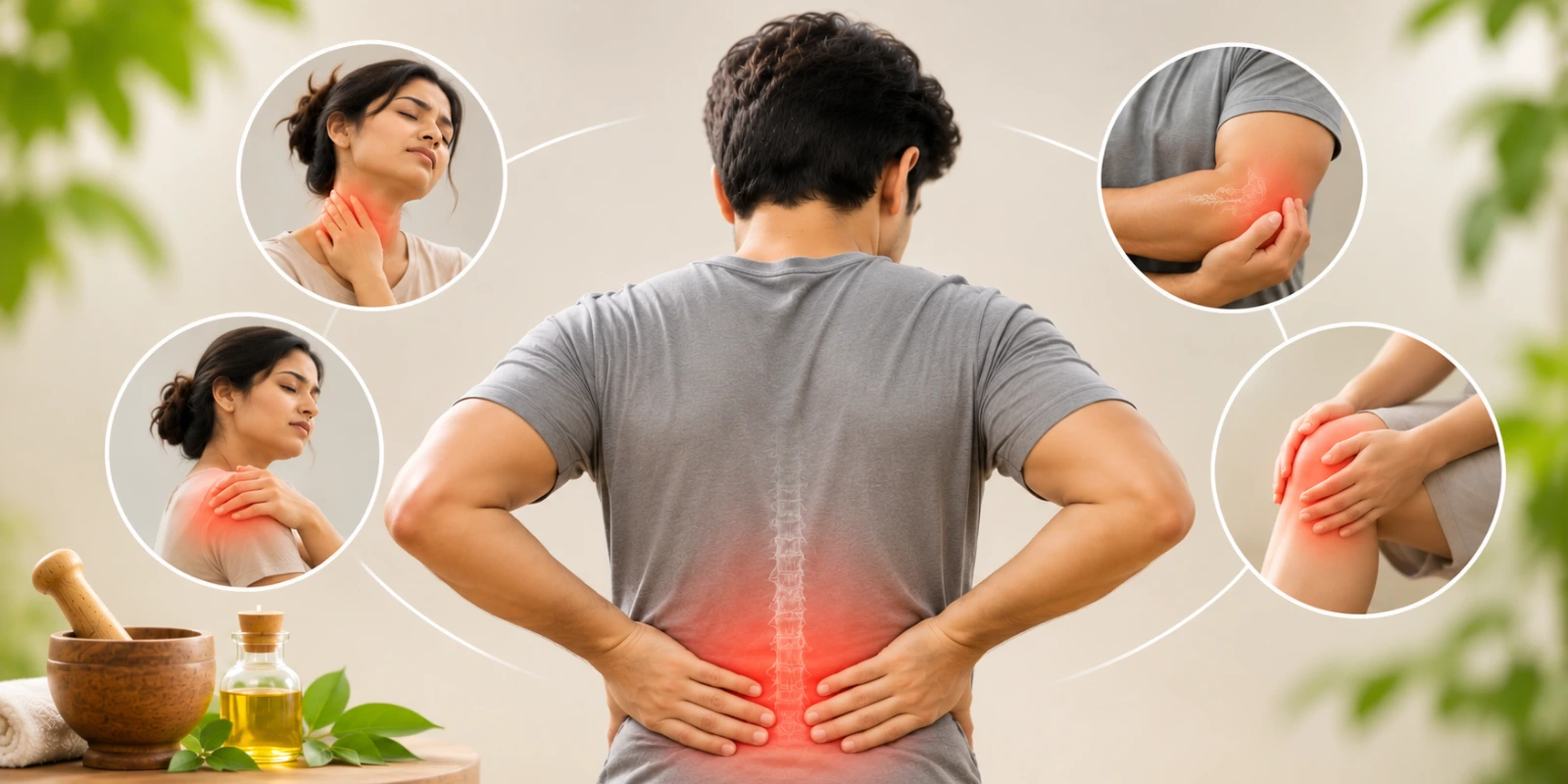
Ayurvedic care is most often sought for musculoskeletal pain. The dedicated guides on this site go deeper on ayurvedic treatment for back pain, knee pain treatment in ayurveda, ayurvedic treatment for frozen shoulder and ayurvedic treatment for tennis elbow, and the table below shows where care typically fits.
| Condition | Where Ayurvedic care typically fits |
|---|---|
| Back pain | Warm oil therapies, local basti, posture correction |
| Neck pain and cervical spondylosis | Oil massage, swedana, lifestyle changes |
| Knee pain and osteoarthritis | Oils, local basti, sometimes Panchakarma |
| Frozen shoulder | Warm oil therapies and gentle mobilisation |
| Tennis elbow | Targeted massage with medicated oils |
| Muscle strain, sprains, tendon irritation | Oil massage, heat, rest and gradual return to movement |
| Sciatica, disc and nerve-related pain | Supportive care, after medical assessment |
Kayakalpa's pain programmes also list sciatica, slipped disc, osteoarthritis, neuropathy, repetitive strain and fibromyalgia. For nerve-related conditions in particular, get a medical diagnosis first and treat Ayurvedic care as a supportive option.
What the Evidence Says, and What It Does Not
The honest summary is that Ayurvedic pain care has a long tradition and a thin evidence base.
The NCCIH, part of the US National Institutes of Health, describes Ayurveda as one of the world's oldest medical systems and notes that there is little scientific evidence of its value for most health problems. It points to a small pilot study of 43 people with rheumatoid arthritis in which Ayurvedic and conventional treatments appeared similarly effective, and it labels that finding preliminary. Beyond that, most published work on Ayurvedic pain treatment consists of small, uncontrolled studies and case reports. They suggest the approach deserves rigorous testing. They cannot show that the treatment caused the improvement.
On safety, the picture is mixed. External therapies such as oil massage are generally low-risk when done by trained therapists, with skin irritation or oil allergy the usual concerns. Oral medicines are where the risk sits, because of the contamination problem described earlier. A study of Ayurvedic medicines sold online found detectable lead, mercury or arsenic in about one in five.
Meanwhile, for persistent musculoskeletal pain in general, staying active, sleeping well and managing stress are among the best-supported approaches in any system. A sensible way to read all this: pain management in ayurveda is a reasonable complementary option for non-urgent musculoskeletal pain, especially when it comes with real changes in movement and routine. It is not a proven replacement for medical assessment.
When Ayurvedic Pain Care Should Not Be the First Step
Some pain needs a doctor before anything else. Seek medical care promptly if you have:
- Pain after a fall, accident or blow, or any suspicion of a fracture
- Fever, unexplained weight loss, or pain that is worse at night and does not ease with position
- Weakness or numbness that is spreading, or any change in bladder or bowel control
- A joint that is hot, red and swollen
- Chest pain, breathlessness, or pain spreading to the jaw or left arm (call emergency services)
Where scans show advanced structural damage that needs surgery, orthopaedic care leads, and Ayurvedic therapies may come in later as support. Tell any physician about diabetes, blood thinners, pregnancy, skin conditions or allergies before starting oil-based or Panchakarma therapies, as they can change what is safe.
What a Programme Looks Like in Practice
At Kayakalpa the pain programmes are physician-led. Dr. Asha Rajeev (BAMS, PGDYT, Diploma in Naturopathy) designs and supervises each plan, and programmes can run for 1, 3, 7, 14 or 21 days depending on the condition and your goals. The usual shape is:
1
Consultation and examination
History of the pain, what has been tried, existing scans and reports, daily habits.
2
A written plan
Which therapies, how many days, and what the plan is meant to achieve.
3
Daily sessions
Typically oil massage with heat or a local therapy, supervised by trained therapists.
4
Review and adjustment
The physician checks your response and modifies the plan if needed.
5
Aftercare
Advice on posture, movement, sleep and food, so that the improvement is easier to keep.
How long relief lasts depends on the condition and on what changes at home. Programmes that include habit changes tend to give the clearest reason to expect it to last, but no clinic can promise a permanent result.
Choosing a Clinic Wisely
If you are weighing up pain management in ayurveda at any clinic, a few signs separate a careful one from a careless one.
- The doctor examines you before suggesting therapies
- The plan is explained in plain language
- Limits are acknowledged, including when to get a scan or see a specialist
- There are no guarantees of cure
- Nobody pushes oral medicines you cannot identify
Kayakalpa is a physician-led clinic in Pettah, Trivandrum. If you would like to talk through a long-standing pain problem, the programmes page has the full list of conditions treated and an option to request a callback, or you can message the clinic on WhatsApp.
Frequently Asked Questions
Some people report benefits and small studies show symptom improvement, but high-quality trials are limited, so it is best seen as supportive rather than proven.
It depends on the condition, and programmes at Kayakalpa range from a single day to 21 days, with follow-up as the physician advises.
Often yes, but tell both your Ayurvedic physician and your regular doctor, and do not stop prescribed medicines without advice.
It is commonly sought for joint and spine pain in later life, but the plan needs to account for other illnesses and medicines.
It is usually warm and gentle, and pressure can be adjusted, so tell the therapist if anything is uncomfortable.
It uses oils chosen by a physician for your condition and focuses on specific areas, often with heat, whereas a relaxation massage is general.
It is most often sought for musculoskeletal pain such as back, neck, knee and shoulder pain, while nerve-related and unexplained pain should be checked medically first.
Not always, since some people do well with oils and swedana alone, and the physician decides based on your condition and strength.
Mild ones can include skin irritation, oil allergy or tiredness after intensive therapies, and unregulated oral products carry a separate heavy-metal risk.
If you develop new numbness, weakness, fever or a sharp worsening of pain, pause the treatment and get medical advice.