
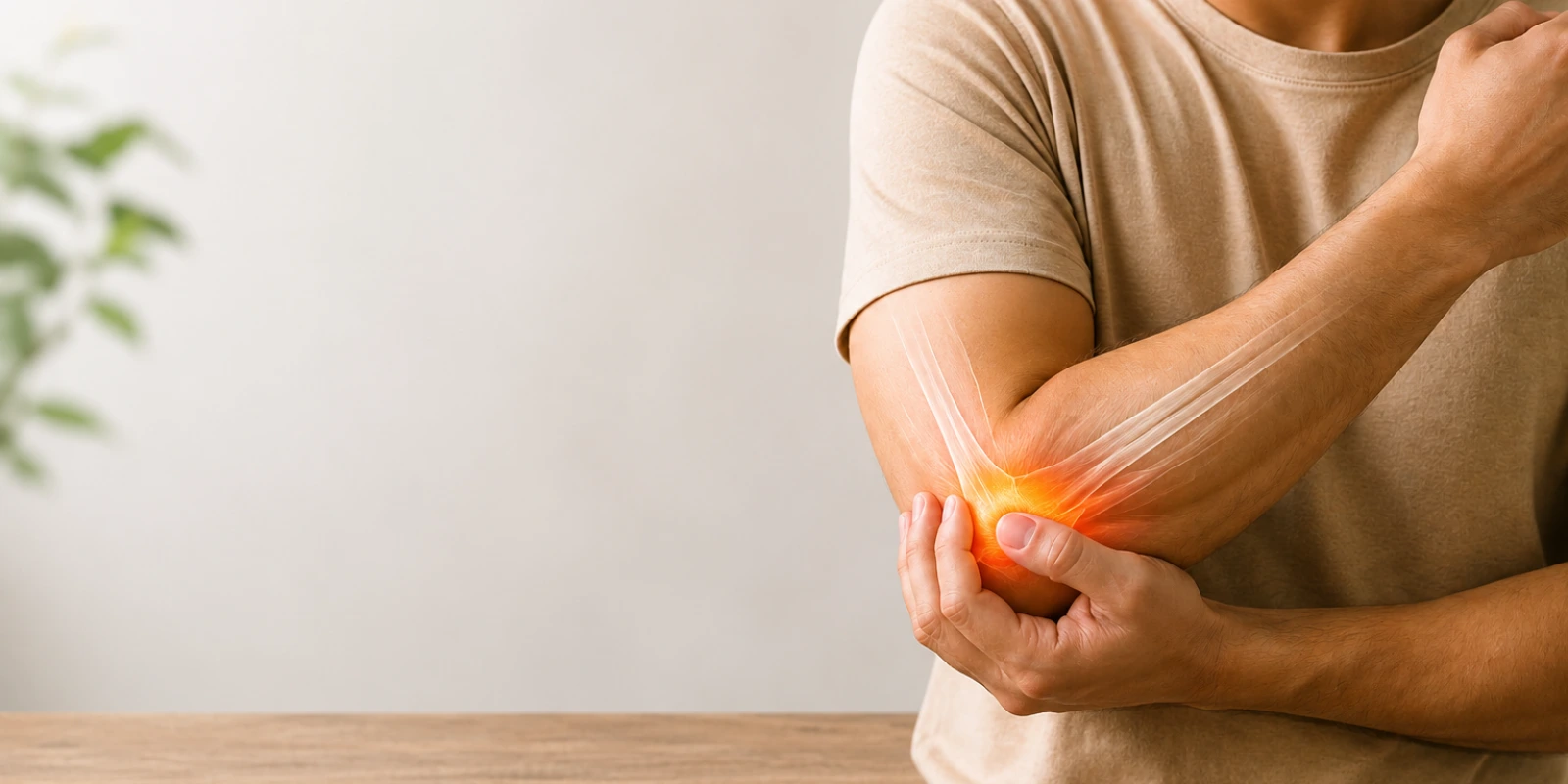
You don't need to play tennis to get a tennis elbow. Typing, lifting, gripping tools, even carrying groceries can gradually inflame the tendons on the outside of the elbow until a simple handshake starts to hurt. If you've been looking into ayurvedic treatment for tennis elbow, it's probably because rest and over-the-counter gels have only offered short-term relief before the pain crept back. Ayurveda approaches tennis elbow, known as Kurpara Vata, as a localized Vata aggravation affecting the tendons and connective tissue, which is why lasting recovery depends on more than just avoiding the aggravating activity.
What Causes Tennis Elbow, Ayurvedically Speaking?
Tennis elbow results from repetitive strain on the forearm tendons that attach at the elbow. In Ayurvedic terms, this repetitive micro-trauma aggravates Vata in the localized tissue, drying it out and reducing its natural elasticity, which is why the pain often worsens with grip-based movements like turning a doorknob or lifting a cup.
| Common Trigger | Ayurvedic Interpretation |
|---|---|
| Repetitive gripping or typing | Localized Vata aggravation in forearm tendons |
| Heavy lifting with poor wrist posture | Tissue strain compounding Vata imbalance |
| Racket sports or manual labour | Direct mechanical stress on tendon attachment |
| Ageing tendons | Natural decline in tissue elasticity (reduced Kapha) |
| Poor circulation to the forearm | Slower healing, prolonged Vata stagnation |
It's worth noting that tennis elbow rarely results from a single incident — it typically builds up over weeks or months of repeated strain before the pain becomes noticeable enough to address. This gradual onset is exactly why a short course of rest often doesn't resolve it: the tendon needs active support to rebuild the elasticity it has gradually lost, which is the core aim of ayurvedic treatment for tennis elbow.
Tennis Elbow vs. Golfer's Elbow: Know the Difference
Not all elbow pain is tennis elbow, and getting the diagnosis right matters before starting any therapy plan.
| Condition | Location of Pain | Common Cause |
|---|---|---|
| Tennis Elbow (Lateral Epicondylitis) | Outer elbow | Repetitive wrist extension — typing, lifting with palm down |
| Golfer's Elbow (Medial Epicondylitis) | Inner elbow | Repetitive wrist flexion — gripping, throwing, lifting with palm up |
Both conditions respond to a similar Ayurvedic approach — Vata pacification, localized therapy, and tendon-nourishing herbs — but the exact treatment points and poultice placement differ. A proper consultation before starting ayurvedic treatment for tennis elbow ensures the therapy is targeted correctly rather than applied generically to "elbow pain."
Ayurvedic Therapies for Tennis Elbow
A well-designed ayurvedic treatment for tennis elbow plan combines localized therapies to reduce inflammation with treatments that restore tissue elasticity and circulation.
| Therapy | What It Does | Typical Duration |
|---|---|---|
| Abhyanga (Warm Oil Massage) | Improves local circulation and softens tight tendons | 20–30 mins/session |
| Kizhi (Herbal Poultice Massage) | Reduces localized inflammation and stiffness | 20–30 mins/session |
| Local Dhara (Oil Pouring) | Nourishes tendon tissue and eases chronic pain | 20–25 mins/session |
| Lepa (Herbal Paste Application) | Provides targeted anti-inflammatory relief | 20 mins/session |
| Swedana (Local Steam Therapy) | Loosens tight tendons before massage therapy | 10–15 mins/session |
A typical course runs 10 to 14 sessions, giving the tendon tissue enough time to actually heal rather than just feel temporarily looser.
Herbal Support for Tennis Elbow
- Mahanarayan Taila — commonly applied for tendon and joint stiffness
- Rasnadi Guggulu — supports inflammation reduction in soft tissue
- Sahacharadi Taila — used for localized Vata-related tendon pain
- Dashamoolarishta — an internal Vata-pacifying formulation, prescribed based on individual assessment
These should be used under guidance from a qualified Ayurvedic physician, since the right combination depends on how long the condition has persisted and how severe the tendon irritation is.
Chiropractic Massage vs. Ayurvedic Therapy for Elbow Pain
Many people researching elbow pain relief also come across chiropractic massage as an option. While chiropractic massage focuses primarily on joint alignment and manual manipulation, Ayurvedic therapy takes a broader approach — combining warm oil massage, herbal poultices, and internal medicine to address both the local tendon irritation and the underlying Vata imbalance driving it.
Some patients find that chiropractic massage offers useful short-term mechanical relief, but without addressing tissue dryness and inflammation from within, the pain often returns once activity resumes. This is why ayurvedic treatment for tennis elbow is frequently chosen by patients who've tried isolated manual therapy and found the relief didn't hold.
The Role of Grip Strength in Long-Term Recovery
A tendon that has been inflamed for weeks or months often loses some of its supporting grip strength, even after the pain itself has eased. This is why a complete ayurvedic treatment for tennis elbow plan doesn't stop once discomfort subsides — it typically includes a gradual reintroduction of light grip and forearm strengthening exercises, guided by your therapist, once the acute inflammation has settled.
Skipping this step is one of the most common reasons tennis elbow returns. The tendon may feel pain-free, but if it hasn't regained its earlier strength and elasticity, everyday gripping activities can re-aggravate it within weeks. Combining Ayurvedic tissue therapy with a slow, supervised return to normal grip strength gives the tendon the best chance of staying resilient long after treatment ends.
Diet and Lifestyle Recommendations
- Reduce cold, dry, and processed foods that aggravate Vata and slow tissue healing
- Include warm, oily, easily digestible meals to support tendon nourishment
- Apply warm sesame oil to the forearm and elbow daily during recovery
- Avoid repetitive gripping activities until inflammation has visibly reduced
- Use ergonomic adjustments at work — proper wrist support while typing, correct grip technique for lifting
- Introduce gentle forearm stretches only once acute pain has settled
How Your Treatment Plan Is Personalized
Tennis elbow can range from a mild, recent strain to a chronic condition that's persisted for months, and treatment needs to reflect that difference. At Kayakalpa, ayurvedic treatment for tennis elbow starts with a consultation that looks at how the injury developed, your daily activities and occupational strain, your Prakriti, and whether related issues like grip weakness or forearm stiffness are present.
Based on this assessment, a physician decides how many sessions are needed, which combination of Kizhi, Dhara, and Lepa therapy suits your case, and which internal herbal formulations will support tendon healing without over-treating a mild strain or under-treating a chronic one. Someone with a recent, mild strain may recover with a short course of localized therapy and rest, while a case that's persisted for over six months typically needs a longer, more structured plan combining external therapy with internal Vata correction.
This is also why generic online remedies or one-size-fits-all braces often underperform — without addressing the specific tendon involved and the individual's constitution, relief tends to be temporary rather than lasting.
Why Address the Root Cause, Not Just the Symptom
Tennis elbow has a well-known tendency to return, especially when the underlying tissue weakness isn't addressed. Ayurvedic treatment for tennis elbow aims to restore the tendon's natural elasticity and resilience through nourishing therapies and herbal support — rather than simply calming inflammation until the next repetitive strain triggers it again.
What to Expect: A Typical Recovery Timeline
Recovery from tennis elbow through ayurvedic treatment for tennis elbow generally follows a predictable pattern, though timelines vary with how long the condition has persisted:
1–4
Early Relief
Reduced sharpness of pain during gripping activities; early relief from Abhyanga and Swedana.
5–8
Inflammation Eases
Noticeable decrease in inflammation; daily tasks like lifting a cup become more comfortable.
9–14
Tissue Strengthening
Continued strengthening of tendon tissue with Kizhi and Lepa therapy; most patients report significant functional improvement.
14
Maintenance
For long-standing or recurrent cases, occasional maintenance sessions and continued ergonomic care help prevent relapse.
Unlike a single anti-inflammatory injection that offers quick but temporary relief, ayurvedic treatment for tennis elbow builds improvement gradually as the tendon tissue itself heals and regains elasticity.
Myths vs. Facts About Tennis Elbow Treatment
When to See a Doctor First
- Sudden, severe pain following a specific injury or fall
- Visible swelling, redness, or warmth around the elbow joint
- Numbness or tingling extending into the fingers
- Pain that doesn't improve after several weeks of rest and therapy
Preventing Recurrence After Treatment
Once ayurvedic treatment for tennis elbow has restored comfortable movement, a few habits help keep the tendon strong and pain-free:
- Continue gentle forearm stretches and strengthening exercises even after pain resolves
- Reassess ergonomics regularly — wrist posture while typing, grip technique while lifting, and racket or tool handle size if relevant
- Apply warm sesame or Mahanarayan oil periodically to maintain tissue elasticity, especially before activities involving repetitive gripping
- Take short breaks during repetitive tasks to avoid re-aggravating the tendon
- Address early warning signs — mild soreness after activity — promptly rather than waiting for it to develop into full inflammation again
Tennis elbow has a well-earned reputation for recurring, but with these habits in place alongside the tissue-strengthening benefits of Ayurvedic therapy, most patients avoid a repeat episode.
Conclusion
Tennis elbow that keeps flaring up despite rest usually points to unresolved tissue strain rather than a condition that will simply fade on its own. Ayurvedic treatment for tennis elbow works by combining targeted external therapies with internal Vata correction — offering a more complete recovery than short-term measures like chiropractic massage alone.
Frequently Asked Questions
Most patients notice reduced pain within 10–14 sessions of structured therapy.
Yes, but repetitive gripping activities should be minimized during the acute phase.
No, it's commonly caused by repetitive activities like typing, lifting, or manual work.
It can offer short-term relief, but often doesn't address the underlying tissue inflammation long-term.
Yes, when recommended by your physician as part of a home-care routine.
Recurrence is reduced significantly when tendon strength and daily habits are properly addressed.
Tennis elbow specifically involves inflammation at the tendon attachment on the outer elbow, unlike generalized strain.
Not usually, but it may be recommended if pain follows a specific injury or doesn't respond to initial therapy.
Yes, repetitive typing and mouse use are common non-sporting causes.
A noticeable reduction in pain during gripping activities is usually the first sign of improvement.